
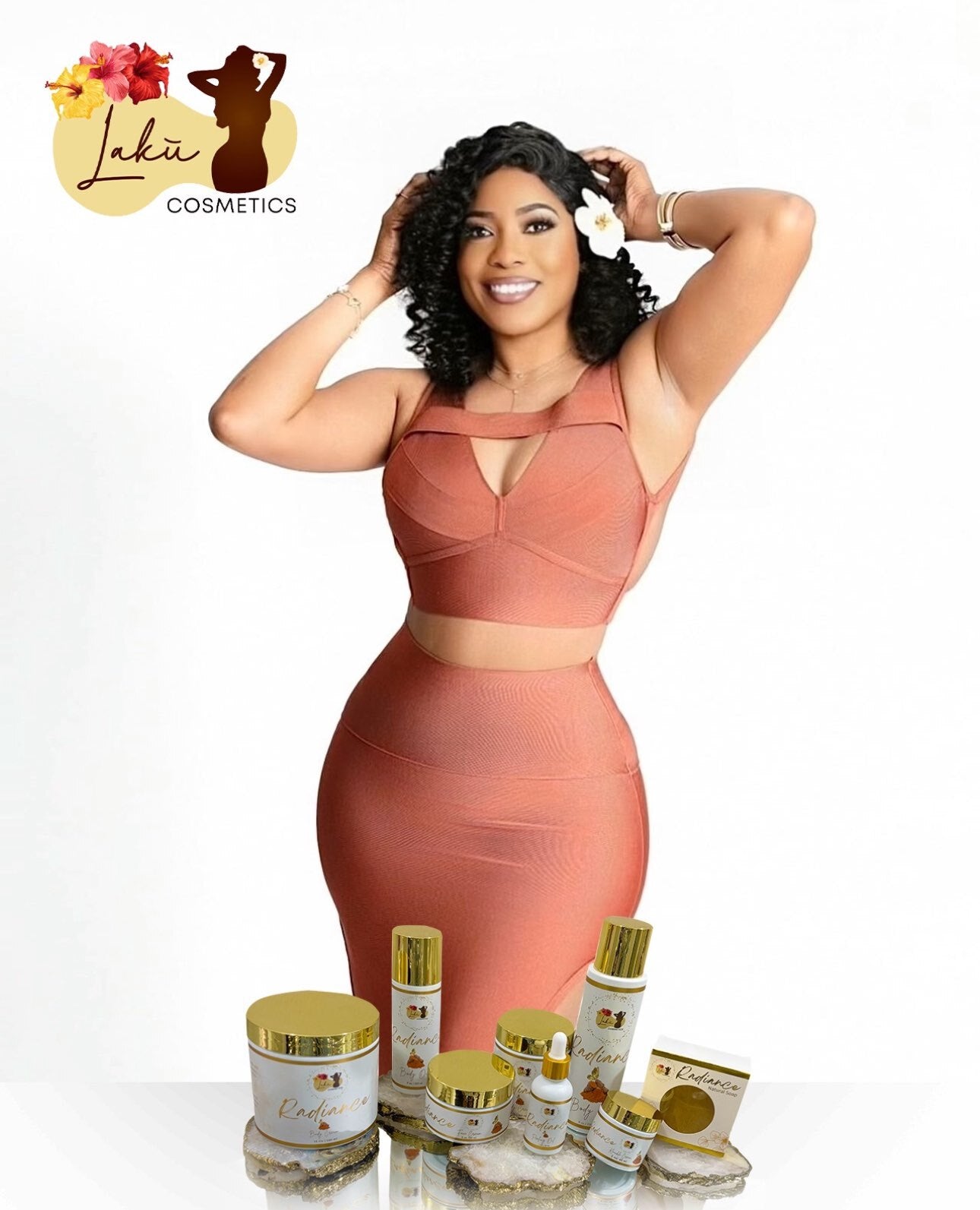
Reviewed by Hally — Certified Skincare Formulator and Repair Specialist
Every Lakū article is reviewed for FDA-compliant language and melanin-rich skin accuracy.
The Meaning of “Lakou”
In Haitian Creole, lakou is the word for a family compound — the backyard space surrounded by a few homes where extended family lives, cooks, raises children, treats wounds, and passes down what works.
The lakou is where my grandmother taught my mother how to use turmeric paste on a small burn. Where my aunties knew which leaves calmed a baby's eczema. Where the first time I ever heard the word kojic was in English, on a YouTube tutorial — but the practice of brightening with kojic-related Asian beauty rituals had already, somehow, traveled into Haitian beauty culture decades before through diaspora exchange.
The lakou wasn't formal. It was practical. Whatever worked got passed down. Whatever didn't, got abandoned. No marketing department. No focus groups. Just generations of women paying attention to what helped melanin-rich skin actually heal.
When I started building products in my kitchen — back when "formulating" wasn't yet on my résumé and "Lakū" wasn't yet a brand — I kept coming back to that. Most of the cosmetics I'd been told were "for me" were built in labs that had never seen our skin. The marketing was for us. The formulation wasn't.
So I built what the lakou had been telling me, plus what the credentials gave me: turmeric, hibiscus, kojic, niacinamide. Tradition meeting clinical.
Lakū means backyard. It's the brand that lives in the space the lakou taught me to value.
Three Haitian beauty traditions that ended up in Lakū
1. Turmeric paste for the look of even skin
In rural Haiti — and in Haitian-American homes that kept the tradition — turmeric mixed with milk, honey, or oil is applied as a face mask before church on Sunday. It supports the look of an even glow on darker skin.
Modern formulation knowledge tells us turmeric's curcuminoids have antioxidant and anti-inflammatory benefits. The grandmothers didn't need the chemistry to know it worked.
In Lakū:
- Radiance Turmeric Soap — turmeric powder layered into the bar
- Radiance Turmeric Face Cream — turmeric extract for daily use
- Radiance Turmeric Body Cream — turmeric layered with the actives stack
2. Hibiscus as flower, food, and balm
The hibiscus flower is everywhere in a Haitian garden. In Caribbean culture, hibiscus is brewed into sorrel (a hibiscus tea) at Christmas; the dried petals are used in food and skin preparations; and the flower is itself a symbol of beauty and resilience.
For skin specifically, finely milled hibiscus has gentle exfoliating and brightening properties. The flower contains alpha-hydroxy acids and antioxidants in low concentrations — meaning it can be used regularly without the harsh effects of higher-concentration acids.
In Lakū:
- Radiance Turmeric & Hibiscus Body Scrub — hibiscus flower powder is the heart of the formula
When my customers ask why the scrub is the color it is, I tell them: that's hibiscus. That's strength.
3. Honey for the feel of softer skin
In Haitian beauty traditions, raw honey was used as a gentle cleanser, moisture treatment, and barrier support. The grandmothers who taught me knew that honey's humectant properties mean it pulls moisture into skin.
Honey is in two of our products. (And those two products aren't vegan because honey is an animal product — we're transparent about that.)
In Lakū:
- Radiance Turmeric Soap — honey as a slurry component
- Radiance Turmeric Face Cream — honey integrated into the daily moisturizer
What changed when these traditions met formulation
The grandmothers' wisdom got me 80% of the way to the products I make today.
The other 20% came from getting certified as a skincare formulator. That's where I learned:
- Why turmeric works (curcumin's interaction with melanocyte signaling)
- How kojic acid is gentler than free kojic when used as kojic dipalmitate
- When alpha-arbutin is more appropriate than hydroquinone (always)
- What chemical filters do for melanin-rich skin that mineral filters can't
Tradition is the why. Formulation is the how. You need both.
Lakū is what happens when you respect the lakou and the lab.
Why Haitian heritage matters in skincare specifically
Most skincare brands marketing to Black women are run by people who don't share that heritage. The intent is often good. The formulations often miss.
Specifically, three things tend to happen when skincare for melanin-rich skin is formulated by people without that lived experience:
-
Sunscreen leaves a cast. The formulators didn't test on Fitzpatrick V or VI skin. Or they did, and decided "white-cast is acceptable." It isn't.
-
The "brightening" actives are the wrong ones. Hydroquinone gets prescribed because it's fast — without acknowledging the long-term ochronosis risk for melanin-rich users. Or kojic acid is used at concentrations that work but irritate. Or vitamin C is dropped in without understanding how it interacts with our pigment-making cells.
-
The marketing is patronizing. "For all skin types" — except the formulation tells you it isn't. "Heritage-inspired" — without anyone from that heritage on the team. "Empowering" — instead of useful.
Lakū is run by someone whose grandmother taught her about turmeric. Whose family used hibiscus before any beauty company sold it. Who got certified specifically because she watched too many women in her community get harmed by products that were never made for them.
That doesn't make Lakū the right brand for everyone. But it does mean the formulation, the language, the routines, and the boundaries are coming from inside the lakou — not from outside it.
What this means for our customers
When you buy from Lakū, you're not just buying a product. You're buying:
- Formulation built around how your skin actually works
- Sunscreen that disappears on melanin-rich skin (because we tested it on melanin-rich skin)
- The hard line on bleaching (we don't make products to lighten skin, period)
- The hard boundary on hydroquinone (we don't recommend it, ever)
- The honest timeline (8–16 weeks for visible change, 6 months for the "wait, did your skin change?" comments)
- The patience and pacing of a tradition that pre-dates Instagram by hundreds of years
You're also buying into a community. Lakū means lakou — the backyard. Tag #LakūLakou on your before/afters, your routine clips, your "this finally worked" posts. We see you.
Read more about Lakū → Take the quiz → Shop the line →
A final note on heritage
I sometimes get asked: "Aren't you worried about being too narrow? Most of your customers won't be Haitian."
Here's the honest answer: my customers are who they are. Most of my best customers are Black women — Haitian-American, African-American, Afro-Latina, Caribbean diaspora — who've been let down by other brands. Some are South Asian women dealing with PIH after pregnancy. A few are Filipino, Korean, mixed-race, or simply melanin-rich skin from any background.
What they all have in common: their skin wasn't built around in the formulation labs that designed most "luxury" skincare. They came to Lakū because finally a brand was making products with their skin in mind — and being honest about it.
The heritage isn't a wall. It's an anchor. It's the thing that keeps the brand honest. The lakou is open to anyone — but it's still the lakou.
Welcome.
— Hally Certified Skincare Formulator · Founder of Lakū Cosmetics · Made in New Orleans · Rooted in Haitian heritage
— Hally · Certified Skincare Formulator · Lakū Cosmetics


