
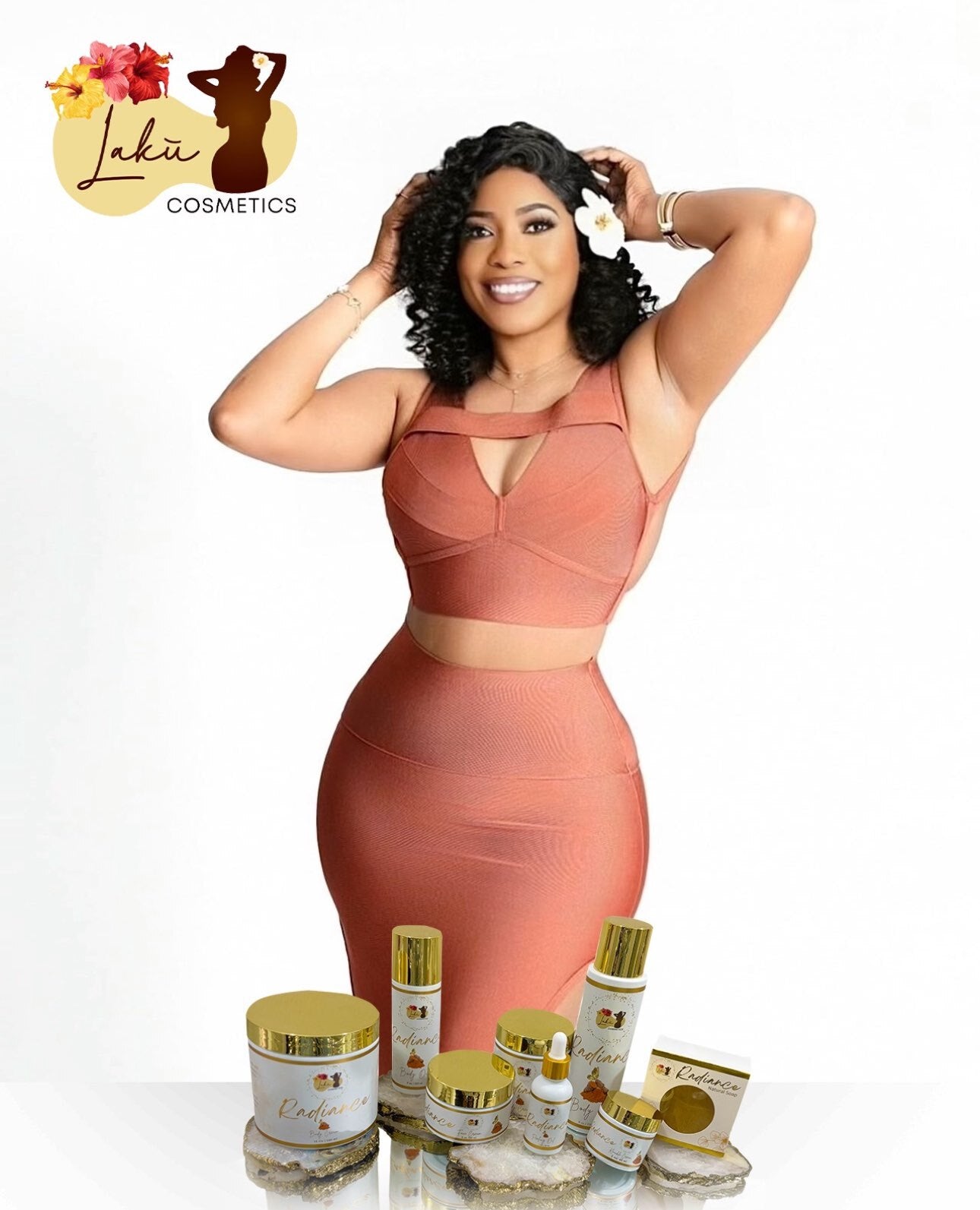
Reviewed by Hally — Certified Skincare Formulator and Repair Specialist
Every Lakū article is reviewed for FDA-compliant language and melanin-rich skin accuracy.
What you'll learn
By the end of this guide, you'll know:
- The four most common types of marks melanin-rich skin develops
- How to tell them apart (because the routine for each is different)
- What the timeline actually looks like
- Which products help, which don't, and which can make things worse
- The honest version — no "miracle 7-day fade" promises
A few things first
I'm Hally. I'm a certified skincare formulator and the founder of Lakū Cosmetics. I built this brand after watching too many of my clients come to me already burned by hydroquinone, harsh bleaching agents, and trend-driven products that were never made for their skin.
This guide is the version I wish someone had given me when I was 22.
It's long. Save it.
The 4 types of marks
When melanin-rich skin develops marks, it's almost always one of these four:
- PIH — post-inflammatory hyperpigmentation
- PIE — post-inflammatory erythema
- Melasma
- Ochronosis (caused by long-term hydroquinone use)
The first step in any honest skincare conversation is figuring out which one you have. They look similar in photos. The treatments are different. Some routines that help one will make another worse.
Let's go.
1. PIH — Post-Inflammatory Hyperpigmentation
What it is
PIH is the brown or dark mark that's left behind after a pimple, ingrown hair, eczema flare, or any kind of inflammation has healed.
The inflammation itself is gone. The pigment is staying behind.
This happens because melanin-rich skin's pigment-making cells (melanocytes) are more responsive than skin with less melanin. When skin gets inflamed, our melanocytes overreact — they pump out extra pigment as part of the healing response. The acne is gone in two weeks. The mark sticks around for months.
This is the most common thing I help people with. It's also the most responsive to a steady routine.
How to identify it
- Color: brown, tan, or dark brown
- Edges: typically follow the shape of the original inflammation (round if it was a pimple, linear if it was an ingrown)
- Location: anywhere skin was previously inflamed
- Press on it with a clear glass: the mark stays visible (this rules out PIE)
What helps
Niacinamide, alpha-arbutin, kojic acid, vitamin C, retinol, and consistent sunscreen.
Niacinamide and kojic acid help support the look of more even tone over time. Alpha-arbutin works on the pigment-making cells without changing your natural skin color. Retinol supports cell turnover. Vitamin C is a brightening adjunct.
But the real trick? Sunscreen every single day. UV radiation reactivates the pigment response. Without sunscreen, you're undoing the work of every product you apply.
Honest timeline
- 30 days: barrier stable, slight evening of overall tone
- 60 days: lighter marks visibly less pronounced
- 90 days: deeper marks noticeably less visible
- 6 months: family starts asking what changed
Don't trust the mirror. Take photos.
What to use from Lakū
- Soap for daily cleanse (kojic dipalmitate)
- Face Cream for daily moisture (turmeric, gentle barrier support)
- Body Cream on body areas only (the actives stack: niacinamide + glycolic + alpha-arbutin + kojic + retinol)
- SPF 60 every morning, no exceptions
→ Take the quiz for a tailored PIH routine.
2. PIE — Post-Inflammatory Erythema
What it is
PIE is the red or purple mark in the same situation where PIH is brown. Different mechanism. Different treatment.
Where PIH is pigment, PIE is vascular — your skin's blood vessels showing through more visibly because of the inflammation that just healed.
Brightening actives don't help PIE. They were built for pigment, not blood vessels.
How to identify it
- Color: red, pink, or purple
- Edges: usually softer, more diffuse than PIH
- Press on it with a clear glass: the mark fades or disappears under pressure (this is the key test — pigment doesn't change under pressure, blood does)
What helps
PIE responds to:
- Time (sounds frustrating but it's true — PIE is your skin healing; the mark fades as the vasculature settles)
- Barrier support (anything that calms irritation helps the underlying inflammation resolve faster)
- Sunscreen (UV exposure delays vasculature healing — same as with PIH)
- NOT brightening actives (won't hurt, but won't help)
- NOT harsh exfoliation (can make PIE worse by triggering more vascular response)
Honest timeline
PIE often takes 3–6 months to fully resolve. There's no real "speeding it up" — only "not slowing it down."
What to use from Lakū
- Face Cream for daily barrier support
- SPF 60 every morning
- Soap for gentle cleansing
- Skip the Peeling Oil and Body Cream actives until PIE has fully resolved
3. Melasma
What it is
Melasma is patchy hyperpigmentation that usually shows up symmetrically on the cheeks, forehead, upper lip, or chin. It's commonly hormone-related — pregnancy, birth control, or other hormonal shifts can trigger it. Sun exposure makes it worse.
Melasma is technically a form of hyperpigmentation, but it behaves differently from PIH. It's more stubborn, more persistent, and more easily reactivated.
How to identify it
- Color: brown, sometimes greyish-brown
- Edges: diffuse, soft, often symmetrical (the same patch on both cheeks, for example)
- Location: cheeks, forehead, upper lip, chin
- Sun reactivity: gets darker after even small sun exposure
What helps
The same actives that help PIH (niacinamide, alpha-arbutin, kojic) help melasma — but the cornerstone is sunscreen, and not just any sunscreen.
For melasma specifically:
- SPF 60+ every day — even indoors near windows
- Hormonal evaluation with a doctor (sometimes addressing the hormonal trigger is what stalls progress)
- Patience — melasma is a 6-12 month routine, not a 90-day one
- Avoid heat (saunas, hot yoga, prolonged sun) — melasma is also heat-reactive
Honest timeline
Melasma is the slowest of these to respond. Plan for 6–12 months minimum of consistent routine. Even then, it can re-flare with sun exposure or hormonal shifts.
What to use from Lakū
- Soap, Face Cream, SPF 60 — the daily core
- Body Cream for cheek/jaw application IF skin is resilient (avoid during pregnancy)
- NOT the Peeling Oil — too aggressive for the typical melasma user
- Wide-brim hats and sun-protective clothing — the products only get you so far without behavioral SPF
If melasma is severe or persistent, we recommend seeing a dermatologist alongside Lakū. Some prescription options (tretinoin, tranexamic acid) work beautifully alongside our line.
4. Ochronosis (the hydroquinone problem)
What it is
Ochronosis is what happens to skin that's been on hydroquinone too long. The skin gets darker, sometimes bluish or grey-brown, especially around the cheeks. It's the opposite of what hydroquinone was supposed to do.
This is the one I see most often in my repair-specialist work, and it's the one that requires the most patience to undo.
How to identify it
- Color: dark brown, sometimes with a bluish or grey tint
- Edges: diffuse, often in the same areas where hydroquinone was applied
- History: 6+ months of consistent hydroquinone use
- Hydroquinone is no longer working — applying more makes the problem worse
If you've been using hydroquinone for more than a few months and your skin is darker than when you started, that's ochronosis. Stop. Talk to your dermatologist. Your skin is telling you something serious.
What helps
The path through ochronosis is:
- Stop the hydroquinone (this is non-negotiable)
- Barrier reset for 30 days — cleanser, moisturizer, sunscreen only. No actives. Let your skin recalibrate.
- Slowly reintroduce gentle actives — niacinamide, alpha-arbutin, kojic acid (in that order)
- Sunscreen every day — the post-hydroquinone skin is especially sensitive to UV
- Patience — ochronosis is the slowest of these to resolve. 12-18 months is realistic.
Honest timeline
Year-long process. Sometimes longer.
What to use from Lakū
- Phase 1 (Days 1–30 — Barrier First): Soap + Face Cream + SPF 60 only. No other actives. Twice daily.
- Phase 2 (Days 31–90): Add Body Cream slowly — every other night for 2 weeks, then nightly. Body areas only.
- Phase 3 (Day 90+): Continue Phase 2; add Scrub once weekly.
- Skip the Peeling Oil for at least 6 months post-hydroquinone.
If you're recovering from hydroquinone, email me directly. This is the work I built Lakū for.
The single most important thing
Across all four conditions, the single most important thing is sunscreen.
UV exposure is what triggered most of these marks in the first place. UV exposure is what makes them stay. Every active ingredient in any skincare line is a no without daily sunscreen.
The reason most sunscreens don't work for melanin-rich skin is they use mineral filters — zinc oxide and titanium dioxide. Those filters work by reflecting UV. They're white. On dark skin, they read grey.
That's why I made Radiance Invisible SPF 60. All-chemical filters. No zinc, no titanium. Goes on clear, stays clear, even on Fitzpatrick V or VI.
Wear it every morning. Reapply every 2 hours of direct sun. This is the only non-negotiable in any routine I recommend.
What about hydroquinone?
Hydroquinone is a strong active that some dermatologists prescribe for hyperpigmentation. It works fast — for some people, in some windows of time.
It also has a long-term cost. Long-term use leads to ochronosis (see above). Pregnancy use is contraindicated. Sun-sensitivity is severe.
I never recommend hydroquinone. The Lakū line is built around the alternatives — alpha-arbutin, niacinamide, kojic acid — that take longer but don't damage skin long-term.
If your dermatologist has prescribed hydroquinone for you and you want to use it, that's between you and them. If you're combining it with Lakū, talk to me first — there are routine sequencing changes I'd recommend.
How to start
If you're not sure which of the four you have, take our 9-question skin quiz. It routes you to the right starting routine in under 2 minutes.
If you want to talk to someone about your specific situation, open the Specialist. It's an AI trained on my formulation logic — it can route you through the basics and escalate to me directly if your situation needs founder-level attention.
If you want to start small, the Glow Starter Kit at $39.99 is the cheapest way to test if Lakū fits your skin.
If you want the full routine: Soap + Face Cream + SPF 60 morning, plus Body Cream evening on body areas.
A final word
I built Lakū because the women in my life kept getting let down by skincare. They'd be on a routine for two weeks, see no change, switch brands. Six months later they'd come back to me with no progress, feeling like their skin was the problem.
It wasn't.
It was the routine. It was the missing sunscreen. It was the wrong product on the wrong concern. It was hydroquinone making things worse over time. It was the lack of a steady, formulator-grade, melanin-aware approach.
Lakū is that approach.
I can't promise miracles. I can promise you the routine that respects how your skin actually works, the products that respect how your skin actually heals, and the timeline that respects how long real change takes.
Take a Day 1 photo. Stick with it for 90 days. Wear sunscreen.
Talk soon.
— Hally Certified Skincare Formulator · Repair Specialist · Lakū Cosmetics
Medical disclaimer: This guide is informational, not medical advice. If you have a persistent skin concern, see a dermatologist. Lakū Cosmetics is a cosmetic line and we don't diagnose, treat, cure, or prevent disease.
— Hally · Certified Skincare Formulator · Lakū Cosmetics


