
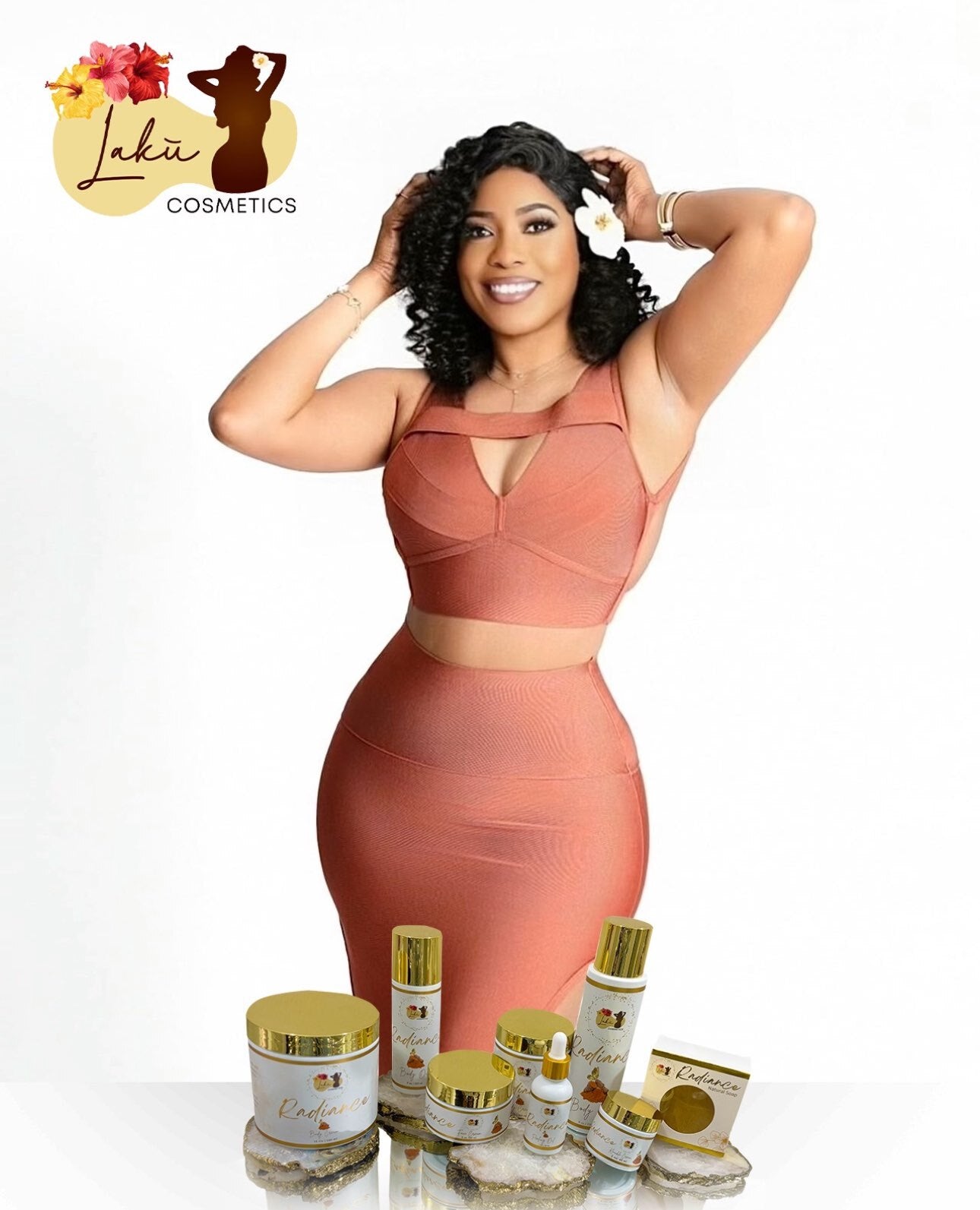
Reviewed by Hally — Certified Skincare Formulator and Repair Specialist
Every Lakū article is reviewed for FDA-compliant language and melanin-rich skin accuracy.
The short answer
If your sunscreen leaves a grey, ashy, or chalky cast on your dark skin, the reason is in two ingredients: zinc oxide and titanium dioxide.
These are mineral filters. They sit on top of skin and reflect UV. They're literally white.
The fix isn't "find a better mineral sunscreen." It's switch to chemical filters, which absorb UV instead of reflecting it. They go on clear and stay clear, even on Fitzpatrick V or VI skin.
If you've been told mineral sunscreens are safer or "more natural," that framing is incomplete for melanin-rich skin. Read on.
How sunscreen actually works
UV radiation comes in two forms that cause skin damage:
- UVB — the burning rays. Cause sunburns, contribute to skin cancer.
- UVA — the aging rays. Penetrate deeper, contribute to hyperpigmentation, photoaging, and the deep-tissue damage that triggers melasma flares.
Sunscreen blocks both. The question is how.
There are two mechanisms:
Mechanism 1: Mineral filters (physical sunscreens)
Active ingredients: zinc oxide and/or titanium dioxide.
These filters work by sitting on the surface of skin and reflecting UV away — like little mirrors. The mineral particles themselves are white.
For light-skin users, mineral sunscreens often blend in adequately because their underlying skin tone is closer to the white of the filters. For melanin-rich skin (Fitzpatrick IV–VI), the white particles read as a grey or ashy cast — sometimes noticeable from across a room.
Some "tinted" mineral sunscreens use iron oxide pigments to mask the cast. These work for some skin tones, but they're rarely matched well across the full range of melanin-rich skin, and the tinting can make application messy or look chalky as it sets.
Mechanism 2: Chemical filters (organic sunscreens)
Common active ingredients: octinoxate, octisalate, avobenzone, octocrylene, homosalate, ensulizole, DHHB (Diethylamino Hydroxybenzoyl Hexyl Benzoate), BEMT (Bis-Ethylhexyloxyphenol Methoxyphenyl Triazine).
These filters work by absorbing UV and converting it to a tiny amount of heat. Different chemistry, different mechanism.
The filters themselves are clear or slightly translucent. They go on transparent and stay transparent across all skin tones — Fitzpatrick I through VI.
This is why every sunscreen I tested before formulating Lakū's SPF 60 either left a cast (mineral) or was disappointing in some other way. I needed an all-chemical filter system, with broad-spectrum coverage, at SPF 60+ — and most brands don't make that combination.
So I made it.
The "but mineral is safer" question
You've probably seen claims that mineral sunscreens are "safer" than chemical sunscreens. Let me be specific about what the research actually says.
Skin absorption: Some chemical filters (oxybenzone, octinoxate) have been shown to absorb into the bloodstream. This was widely reported in 2019 FDA studies. The studies did not find harm — they found absorption. The FDA continues to consider chemical sunscreens safe for use.
Coral reef impact: Oxybenzone and octinoxate have been banned in some marine areas (Hawaii, Key West) for ecological reasons. This is a real consideration if you're swimming in protected waters — but it has nothing to do with skin safety on you.
Hormone disruption claims: Most studies that get cited for "endocrine disruption" use doses far exceeding what gets applied dermally. Real-world exposure is orders of magnitude lower than the experimental thresholds.
The actual question for melanin-rich skin: What's the cost of not wearing sunscreen at all?
The cost is severe. UV exposure is the #1 driver of:
- Post-inflammatory hyperpigmentation (PIH) reactivation
- Melasma flares
- Premature photoaging
- Skin cancer (yes — Black skin gets skin cancer; it's often diagnosed later because the cultural assumption is that dark skin "doesn't need" sunscreen)
Wearing a chemical sunscreen daily is dramatically safer than wearing nothing. Wearing a mineral sunscreen daily is also safer than nothing. The real "unsafe" option is the cast leaving you not wearing sunscreen at all because you don't like how it looks.
What's in Lakū's Radiance Invisible SPF 60
Our formula uses these chemical filters in combination:
- Ethylhexyl Methoxycinnamate (Octinoxate) — UVB
- Ethylhexyl Salicylate (Octisalate) — UVB
- Diethylamino Hydroxybenzoyl Hexyl Benzoate (DHHB) — UVA
- Bis-Ethylhexyloxyphenol Methoxyphenyl Triazine (BEMT) — UVA + UVB
- Octocrylene — UVB + photostabilizer
Plus supporting ingredients:
- Sodium Hyaluronate (hydration support)
- Bisabolol (calms the feel of skin)
- Tocopheryl Acetate (vitamin E — antioxidant)
- Arginine (amino acid, supports skin's natural barrier feel)
The formula is SPF 60 broad-spectrum, PA+++ — meeting the highest standard for both UVB and UVA protection.
It's vegan-compatible, it doesn't leave a cast, and it sits well under makeup.
It's not magic. It's chemistry — designed for skin that mineral filters were never going to work for.
Shop Radiance Invisible SPF 60 →
How to use sunscreen so it actually works
Even the best sunscreen fails if applied wrong.
Daily, every day. Even cloudy days. Even indoors near windows. UVA penetrates glass.
Generously. Most people apply 25–50% of the amount used to achieve labeled SPF. Use 1/4 teaspoon for face and neck. Two pumps minimum.
Reapply every 2 hours of sun exposure. Every 80 minutes if swimming or sweating heavily.
Apply before makeup. Sunscreen is the last skincare step, not the first makeup step.
Don't skip ears, neck, hairline, hands. These are the most overlooked + most exposed areas.
Why this matters for the rest of your routine
Every active in any skincare line is a no without sunscreen.
Niacinamide doesn't help PIH if UV is reactivating the pigment-making response. Glycolic acid increases sun sensitivity — which means using it without SPF makes hyperpigmentation worse, not better. Retinol is a pregnancy-no, a sun-sensitivity-yes — without daily SPF, you're undoing the work. Vitamin C is photoprotective in serum form, but it doesn't replace sunscreen.
Skincare and sunscreen aren't separate routines. They're one routine. The skincare does the support work. The sunscreen makes the support work stick.
If you've been wondering why the products you've been using "stopped working" — check your sunscreen. Most of the time, that's the missing variable.
What about reapplication if I'm wearing makeup?
Two practical methods:
- Powder sunscreen — pat over makeup. Easy, doesn't disrupt the look.
- Spray sunscreen — apply at arm's length, then pat to settle.
Lakū doesn't make a powder or spray yet. (We're working on it.) For now, our Radiance Invisible SPF 60 is your morning first layer — and you can layer a powder or spray over makeup throughout the day.
Final word
If you're melanin-rich and not wearing daily sunscreen, the single biggest skincare upgrade you can make is starting today.
If you've avoided sunscreen because the ones you've tried left a cast, try ours. It's the version I made because every other one wasn't working for skin like mine.
If you have hyperpigmentation, read our guide on PIH, melasma, and ochronosis. The whole conversation starts and ends with daily sunscreen.
If you have a specific question about how to layer sunscreen with the rest of your routine, open the Specialist.
— Hally Certified Skincare Formulator · Lakū Cosmetics · Made in New Orleans
— Hally · Certified Skincare Formulator · Lakū Cosmetics


