
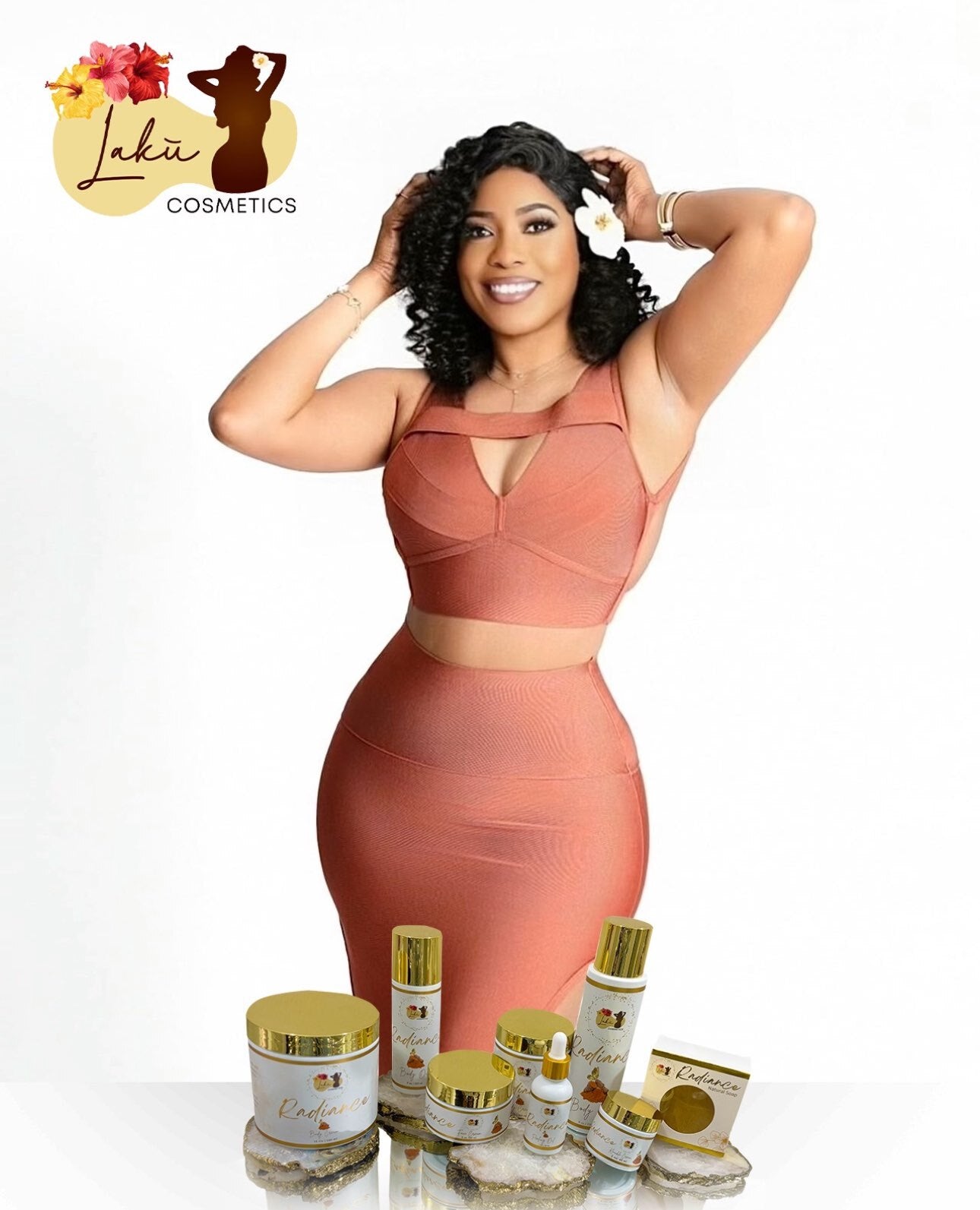
Reviewed by Hally — Certified Skincare Formulator and Repair Specialist
Every Lakū article is reviewed for FDA-compliant language and melanin-rich skin accuracy.
Turmeric has been in skincare for thousands of years. It shows up in Ayurveda, Haitian kitchen remedies, grandmothers' routines, Indian bridal paste traditions. But the real question buyers keep asking is: does it actually fade dark spots, or is it just a cultural heirloom with good marketing?
The honest answer: yes, when it's formulated correctly — and most turmeric skincare isn't. Here's what the science says, why DIY turmeric masks fail, and how we do it differently.
What turmeric actually does (the science)
The active compound in turmeric is curcumin — a polyphenol that's been the subject of hundreds of peer-reviewed studies over the last two decades. Relevant to hyperpigmentation:
- Curcumin inhibits tyrosinase — the enzyme that converts the amino acid tyrosine into melanin. Slow down tyrosinase, slow down pigment production.
- Curcumin is anti-inflammatory — inhibits NF-κB signaling pathways that drive the inflammatory response responsible for post-inflammatory hyperpigmentation.
- Curcumin is a potent antioxidant — neutralizes reactive oxygen species that accelerate pigment formation and skin aging.
A 2020 systematic review of natural ingredients for hyperpigmentation management, published in the National Library of Medicine, found that curcumin showed comparable brightening effects to hydroquinone (the prescription gold-standard for dark spot fading) — but without hydroquinone's side effects.
That's the study-backed side. The practical side is messier.
Why DIY turmeric masks almost always disappoint
If you've tried making a turmeric mask at home and mostly ended up with a yellow-stained face and minimal fading, you're not alone. Three problems:
1. Curcumin has terrible bioavailability
Pure curcumin is hydrophobic — it doesn't mix with water. Your skin barrier is designed to block hydrophobic molecules. So the curcumin in a DIY mask mostly sits on top of the skin (staining it) rather than penetrating into the layers where melanocytes live.
2. Ground turmeric is variable
The curcumin content of ground culinary turmeric varies from 2% to 9% depending on source, age, storage. You literally cannot control the dose of the active you're applying.
3. Masks are low-contact-time
Even if the curcumin could penetrate, 10–20 minutes twice a week isn't enough consistent exposure to make a dent in melanocyte activity.
This is why grandma's turmeric paste traditions were usually part of weekly rituals over months — they were recognizing a timeline that modern DIY TikTok videos skip.
How formulated turmeric skincare solves these problems
When we developed Lakū's Turmeric Face Cream, we had to solve the bioavailability problem. Three formulation choices:
Liposomal curcumin delivery
We use liposomal curcumin — curcumin encapsulated in tiny phospholipid vesicles (liposomes) that mimic your skin's natural lipid barrier. These vesicles slip through the stratum corneum and release curcumin where it can actually reach melanocytes.
Peer-reviewed studies on liposomal curcumin show up to 29x higher bioavailability than free curcumin.
Standardized curcumin concentration
Every batch is formulated to a specific curcuminoid percentage, tested before packaging. You're getting a known dose of active, not a guess.
Daily application, not weekly masks
The cream is designed for twice-daily application. Continuous low-dose exposure — the same principle behind prescription fade creams — produces fade results that weekly masks can't match.
Synergistic actives
Curcumin alone is good. Curcumin + niacinamide + tranexamic acid is dramatically better because they hit three different steps in the melanin pathway:
- Tranexamic acid blocks the signal that tells melanocytes to ramp up
- Curcumin inhibits tyrosinase (slows production)
- Niacinamide blocks the transfer of melanin from melanocytes to surrounding skin cells
Stacking mechanisms is why formulated turmeric skincare can deliver what DIY turmeric masks can't.
What to look for in turmeric skincare
If you're evaluating a turmeric product (Lakū or anyone else), ask:
- What form of curcumin? Liposomal > free-form > ground spice.
- Percentage disclosed? Brands that know their formulation tell you. Brands that don't, don't.
- Anti-inflammatory synergy ingredients? Niacinamide, tranexamic acid, licorice root extract, azelaic acid are all melanin-safe and work well with curcumin.
- Does it stain your skin? Properly formulated turmeric shouldn't leave a yellow cast on your face. If it does, the curcumin isn't encapsulated.
- Fragrance-free or minimal fragrance? Fragrance can trigger inflammation, which causes more PIH.
Turmeric in Lakū's routine
Turmeric isn't one product in our line — it's a thread running through the whole routine.
- Turmeric Face Cream — liposomal curcumin + niacinamide + tranexamic acid, twice daily
- Turmeric Gold Foil Soap — gentle daily cleansing with natural curcuminoids
- Turmeric Body Oil — body hyperpigmentation, post-shower, friction zones
- Turmeric Knuckle Cream — targeted body-hyperpigmentation repair
Each product uses turmeric for its specific job — we're not just slapping turmeric on everything for marketing. The formulations differ by site and concern.
What turmeric skincare can't do
Being honest about limits:
- It's not a miracle. Expect 12–16 weeks for meaningful fade on melanin-rich skin.
- It doesn't replace sunscreen. UV undoes every serum. SPF daily, non-negotiable.
- It won't fix active acne. If you still have active breakouts producing fresh PIH, treat the breakouts first (separately or in parallel).
- It's not a medical treatment for melasma. Hormone-driven melasma often needs a dermatologist + prescription approach.
Take the Skin Quiz
Want to know which Lakū turmeric products are right for your specific concerns? Take our 90-second Skin Quiz — Hally will match you with the exact routine that fits your skin and your consistency level.
FAQ
Is turmeric safe for all skin types?
Yes, in properly formulated skincare. Curcumin is anti-inflammatory and well-tolerated even by sensitive skin. DIY ground-turmeric masks can be irritating due to variable particle size.
How long until I see fading with a turmeric-based routine?
First visible improvement at weeks 4–6 of consistent twice-daily use. Full fade typically at 12–16 weeks. Older post-inflammatory hyperpigmentation (years old) may take 20+ weeks.
Will turmeric stain my skin yellow?
Properly formulated turmeric skincare with liposomal delivery should not leave a yellow cast. If a product stains your skin, the turmeric isn't penetrating — which means it probably also isn't working.
Can I use turmeric with retinol?
Yes. In fact, this is a strong combination — retinol accelerates cell turnover (helping lift existing pigment) while turmeric-based actives suppress new pigment formation. Alternate nights or separate AM/PM is ideal; don't apply both together to avoid irritation.
Can I just eat turmeric for my skin?
Dietary turmeric has systemic anti-inflammatory benefits but very low bioavailability for skin-specific concerns. For topical hyperpigmentation work, you need topical delivery. Both together is better than either alone.


